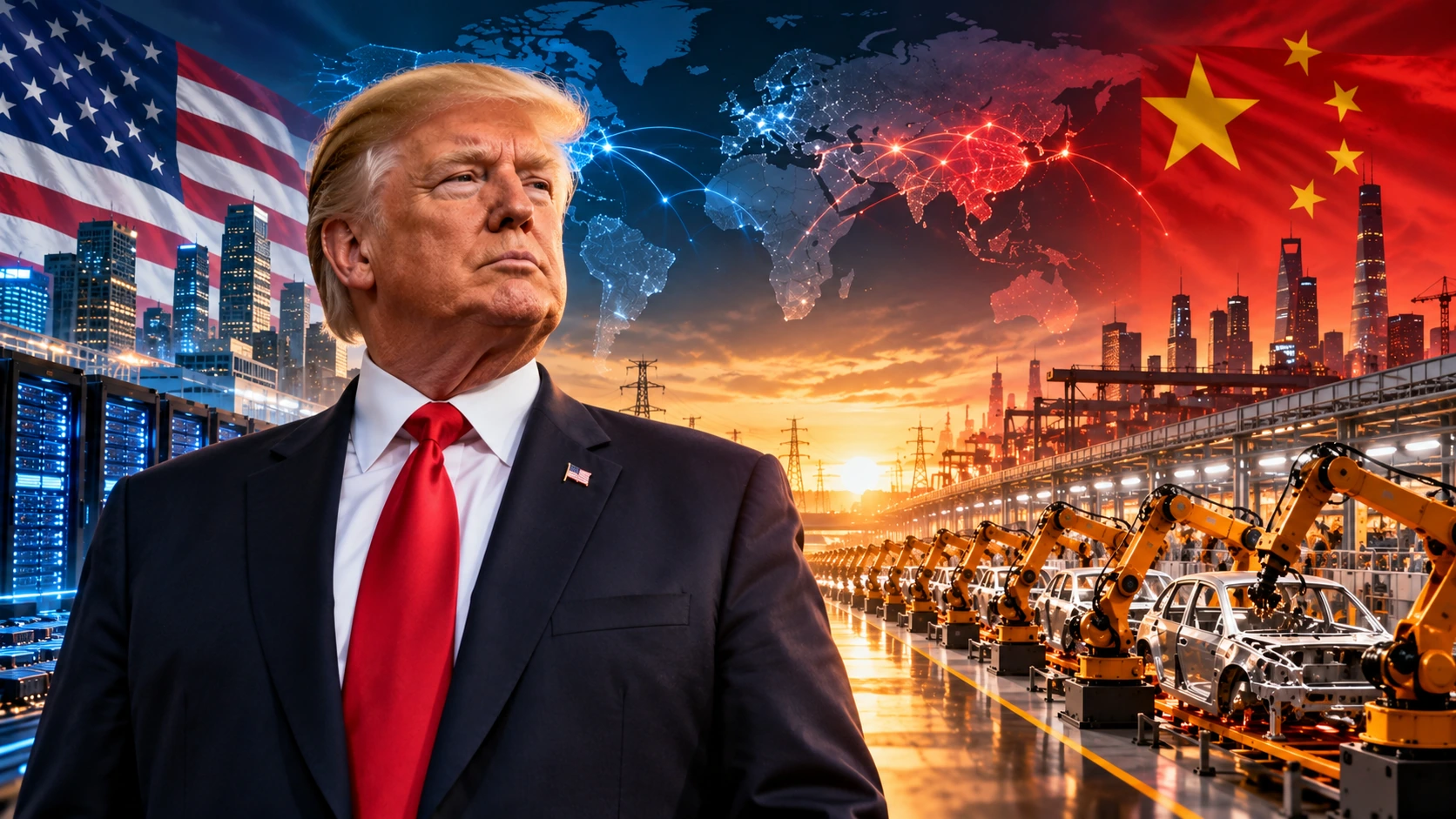
President Donald Trump has been pushing the United States to move faster on artificial intelligence.
His administration has made American AI leadership a national priority. It has pushed for faster innovation, more data centers, more electricity and computing infrastructure, fewer regulatory barriers, greater use of AI throughout government and national security, and stronger American AI influence around the world.
Trump has also made the competition with China explicit. He has said the United States is approximately 18 months ahead of China in AI and argues that America cannot afford to slow down and surrender that advantage.
But how right is he really?
That question is worth asking regardless of how anyone feels about Donald Trump politically.
If you support Trump, the fact that he supports accelerated AI development does not automatically make every part of the strategy right.
If you oppose Trump, his support for accelerated AI development does not automatically make the strategy wrong.
AI is too important for either reaction.
The better question is what the evidence actually shows.
And when we start looking beyond chatbots and examine China's AI development, its manufacturing base, its enormous deployment of industrial robots, America's advantages in advanced computing, and the growing role of AI in national security, Trump's sense of urgency becomes much easier to understand.
At the same time, moving faster creates risks of its own.
The real question may not be whether America should race ahead or slam on the brakes.
It may be whether America can move fast enough to remain a technological leader without moving so recklessly that human beings lose meaningful control over what they are building.
Why the Rush?
Trump's AI strategy is much broader than simply removing regulations.
His administration's America's AI Action Plan organized federal policy around three major areas: accelerating AI innovation, building American AI infrastructure, and strengthening American leadership in international diplomacy and security.
That means AI policy now reaches far beyond companies building chatbots.
It includes semiconductor chips.
Data centers.
Electricity generation.
Transmission infrastructure.
Scientific research.
Cybersecurity.
Military applications.
International technology exports.
And the ability of the United States to maintain technological advantages over its competitors.
That last part matters because the concern about China is not coming only from Trump.
The U.S. intelligence community has identified China as America's most capable AI competitor and says China aims to displace the United States as the global AI leader by 2030.
That tells us something important.
The AI competition with China is not simply political rhetoric or two technology companies fighting over who has the better chatbot.
The United States government considers AI a matter of economic and national security.
China Is Closer Than Many Americans May Realize
For years, it was easy to think of the United States as the unquestioned leader in advanced artificial intelligence.
That picture is becoming much more complicated.
Stanford University's 2026 AI Index found that the performance gap between leading American and Chinese AI models has effectively closed. American and Chinese models have exchanged positions near the top of performance rankings multiple times since early 2025.
As of March 2026, Stanford measured the leading American model ahead of the leading Chinese model by only 2.7 percent.
That doesn't mean China has overtaken America in AI.
America still has major advantages, including more top-tier models, enormous private investment, leading AI companies, advanced semiconductor technology, cloud infrastructure, and an extraordinary amount of computing capacity.
But China is no longer a distant competitor.
And then there are the robots.
Then There Are the Robots
This was one of the most surprising parts of researching this subject.
When people hear "the AI race," they often think about ChatGPT, Gemini, Claude, DeepSeek, or whichever company released the newest model.
But intelligence on a computer screen is only one part of the story.
In 2025, China installed roughly 354,000 industrial robots.
The United States installed about 38,500.
That does not mean Chinese robots are nine times smarter than American robots.
It means China is deploying industrial robotics at a vastly greater absolute scale.
And that distinction could become extremely important as AI moves out of our computers and into the physical world.
A Chatbot Learns Words. A Robot Has to Learn the World.
A language model can learn patterns from enormous quantities of text, images, software code, and other digital information.
A physical robot faces another problem entirely.
Objects have weight.
Surfaces have friction.
Things slip.
People move unpredictably.
Machines break.
Factory layouts change.
A robot has to understand space, movement, balance, force, manipulation, obstacles, failures, and thousands of other interactions with the physical world.
That makes China's enormous manufacturing base potentially important to the future of AI.
The U.S.-China Economic and Security Review Commission has identified the possibility of a reinforcing loop between China's AI development and its industrial economy.
More factories can deploy more robots.
More robots can produce more physical-world data.
That data can help train better embodied AI.
Better AI can make robots more useful.
More useful robots can be deployed in more factories.
And those deployments produce still more data.
The cycle can reinforce itself.
This does not mean China already possesses armies of fully autonomous humanoid robots. Today's humanoid systems still struggle with dexterity, reliability, adaptability, and genuinely autonomous work outside controlled environments.
But China does possess something extremely valuable: scale.
And scale matters.
America Has Advantages China Wants
The picture looks very different when we turn the comparison around.
The United States possesses enormous strengths of its own.
American companies remain among the world's leaders in frontier AI.
The United States has tremendous computing infrastructure.
It has leading cloud providers.
It has enormous private investment.
It has a powerful semiconductor-design ecosystem.
And Stanford reports that the United States hosts thousands of data centers—far more than any other country.
China's efforts to overcome restrictions on advanced computing technology demonstrate just how valuable some of these advantages are.
So asking, "Who is winning the AI race?" may be the wrong question.
There isn't one AI race.
There are several races happening at once.
There is a race for the most capable models.
A race for advanced chips.
A race for computing power.
A race for electricity.
A race for scientific breakthroughs.
A race for robotics.
A race for manufacturing.
A race for talent.
And increasingly, a race to combine all of them.
The country that builds the smartest chatbot does not necessarily win.
The more consequential question may be which country can successfully combine intelligence, computing, energy, manufacturing, robotics, infrastructure, and real-world deployment.
Why Trump Keeps Talking About Electricity and Data Centers
Once AI is viewed this way, another part of Trump's strategy starts making more sense.
Electricity.
Advanced AI requires enormous computing resources.
Those computers require data centers.
Data centers require tremendous amounts of electricity, transmission capacity, cooling, land, equipment, and investment.
And those things cannot simply appear overnight.
An AI model can improve dramatically in months.
A major power plant, electrical transmission project, semiconductor fabrication facility, or massive data-center campus can take years to build.
That means a country concerned about its technological position cannot necessarily wait until it loses an advantage before deciding to build the infrastructure needed to regain it.
Trump's administration has therefore made AI infrastructure a central part of its strategy, including efforts to accelerate permitting for data centers and the infrastructure that powers them.
There are legitimate questions about what that expansion means for electricity prices, communities, land, water, and the electrical grid.
Those questions should not be dismissed.
But neither should the strategic importance of the infrastructure itself.
The Race Is Moving Off the Screen
There is another reason this competition deserves attention.
AI is moving into national security.
The U.S. intelligence community has warned that AI can affect weapons and systems design, targeting, decision-making, cyber operations, and other military capabilities.
Trump's administration has directed national-security agencies to accelerate their adoption of advanced AI while maintaining accountability and human control.
The Pentagon has also created a new Autonomous Warfare Command focused on expanding the military's use of autonomous and robotic systems.
That does not mean a science-fiction robot war is about to begin.
It means something much more concrete:
The U.S. military believes AI-enabled autonomous systems are important enough to change how it organizes for future warfare.
At that point, AI leadership stops being merely a question about which company makes the best consumer product.
It becomes part of national power.
So What Happens If America Slows Down?
This is where Trump's argument becomes particularly difficult to dismiss.
Suppose the United States deliberately slows advanced AI development.
American companies could gain more time for testing.
Researchers could have additional time to study model behavior.
Government could develop better safeguards.
Security practices could mature.
Those are genuine potential benefits.
But there is a problem.
America can decide how quickly America develops AI.
America cannot unilaterally decide how quickly China develops AI.
An American slowdown is therefore not necessarily a global slowdown.
If China continues developing advanced systems while American development slows, the result may not be less powerful AI in the world.
The result could simply be that someone else develops the leading systems.
That matters economically.
It matters technologically.
And if AI becomes increasingly important to military and national-security capabilities, it matters strategically as well.
This is one of the strongest parts of Trump's argument.
America cannot preserve technological leadership merely by trying to prevent competitors from advancing.
It has to continue advancing too.
But What Happens If Nobody Slows Down?
This is where the other side of the argument becomes just as important.
Imagine America says:
China is moving quickly, so we have to move faster.
China looks at America and says:
America is moving quickly, so we have to move faster.
Then American companies look at one another.
One company spends another six months testing a powerful system.
Another releases first.
The company that releases first captures customers, investment, data, and market share.
Suddenly everyone has an incentive to move faster.
Testing takes time.
Security testing takes time.
Red-team exercises take time.
Understanding unexpected model behavior takes time.
And competitive pressure can make time feel like something nobody can afford.
The 2026 International AI Safety Report identifies exactly this problem: competitive pressure can create incentives for companies and countries to prioritize speed over additional safety work.
That doesn't mean development should stop.
It means competition itself can become a risk factor.
Maybe "Go" Versus "Stop" Is the Wrong Choice
This is where I think the AI debate too often becomes unnecessarily binary.
One side says:
AI is dangerous. Slow down.
The other says:
AI is strategically important. Get out of the way.
But those aren't necessarily the only choices.
America can continue developing powerful AI.
America can build data centers.
America can expand energy production.
America can invest in semiconductor technology.
America can develop robotics.
America can apply AI to science, medicine, cybersecurity, defense, and manufacturing.
And America can simultaneously demand serious testing, cybersecurity, accountability, human oversight, and clearly defined boundaries around high-consequence uses.
Interestingly, Trump's current policy already contains elements of both acceleration and safeguards.
His national-security AI directive calls for rapid adoption of advanced systems while also requiring accountability, controllability, security, and human responsibility.
The legitimate question isn't whether safeguards should exist.
It is whether those safeguards are strong enough for systems whose capabilities continue to grow.
Competition Does Not Rule Out Cooperation
There is another possibility that deserves more attention.
America and China can compete intensely in AI while still recognizing that some outcomes would be disastrous for both countries.
Neither country benefits from an accidental AI-driven military escalation.
Neither benefits from an uncontrolled cyber incident.
Neither benefits from an autonomous system mistakenly triggering a larger confrontation.
Neither benefits if increasingly powerful systems become impossible for their creators to reliably control.
The United States and China have already agreed to begin an AI dialogue that includes risks, benefits, and communication mechanisms for AI-related incidents.
That is only a beginning.
But the principle matters.
Competition does not require refusing to communicate about catastrophic risks.
We managed similar tensions during previous periods of technological and military competition.
AI may require its own version of that thinking.
Human Control Is the Line That Matters
This is where the AI race connects directly with the larger argument behind The Necessary Evil series.
Technological leadership matters.
Economic strength matters.
National security matters.
America should care whether another country develops capabilities that could place Americans at a strategic disadvantage.
But there is another question that cannot disappear simply because the competition is real:
Who remains responsible?
The U.S. intelligence community itself has publicly emphasized the importance of humans remaining in control of AI and the machines AI may operate.
That principle matters whether the AI belongs to America, China, a technology company, the military, a hospital, a school, a church, or someone sitting at home.
AI can recommend.
AI can analyze.
AI can automate.
AI can dramatically increase what people are capable of doing.
But capability and authority are not the same thing.
Human beings remain morally responsible for the decisions they delegate to machines.
So, How Right Is Trump Really?
The evidence gives Trump's sense of urgency substantial support.
China is a serious AI competitor.
Its frontier systems have advanced rapidly.
Its manufacturing capacity is enormous.
Its deployment of industrial robotics dwarfs America's in absolute numbers.
AI is becoming increasingly important to cybersecurity, scientific research, economic productivity, autonomous systems, and national defense.
And some of America's most important advantages—advanced computing, semiconductors, frontier research, capital, and infrastructure—should not be assumed to remain permanent simply because America possesses them today.
So when Trump argues that America cannot simply stop advancing while competitors continue moving forward, there is a serious strategic argument behind what he is saying.
But that does not mean speed should become the only measure of success.
Winning an AI race while losing meaningful human control would be a hollow victory.
So would building enormous technological capability while ignoring security, reliability, accountability, workers, communities, or the consequences of increasingly autonomous systems.
The real challenge is harder than "speed up" or "slow down."
America needs to remain capable.
America needs to remain innovative.
America needs to remain competitive.
And America needs to remain responsible for the technology it creates.
The Real AI Race
The most important AI competition may ultimately not be about who releases the smartest chatbot.
It may be about who can best combine:
intelligence
computing power
energy
manufacturing
robotics
infrastructure
security
and, most importantly,
human judgment.
Trump is right to draw attention to the strategic importance of moving forward.
But moving forward should never mean surrendering the driver's seat.
The goal should not simply be faster AI.
It should be powerful AI that remains a tool of human beings rather than the other way around.
Practical Takeaway
You do not have to be a president, military commander, AI researcher, or technology executive for this principle to matter.
Everyday AI users face the same decision on a smaller scale.
Use AI to move faster.
Use it to learn.
Use it to create.
Use it to solve problems.
Use it to accomplish things that would have taken much longer without it.
But verify important information.
Understand what you are delegating.
Know when the consequences require human judgment.
And never confuse a machine's ability to produce an answer with the authority to make the decision.
The AI race may be global.
Human responsibility remains personal.
Related reading
Explore The Necessary Evil series
AI can extend human capability without becoming the authority over human judgment, responsibility, or dignity.
Find Your Book