A reader-first series guide
Which Necessary Evil Book Is Right for You?
Four books. Four different AI questions. Start with the one you're trying to answer.
Each book stands on its own. You do not need to read the series in order.
Find Your Book
Start here
What are you trying to understand or accomplish with AI?
Choose the statement that sounds most like you. Each choice moves to a full explanation, not a stored quiz result.
More than one sounds like me →
Private by design: your choice stays in your browser. There is no form, account, cookie, or response storage.
The big picture
Four ways into the same conversation
- Book 1Understand what is at stake
- Book 2Direct AI clearly
- Book 3Use AI faithfully
- Book 4Orchestrate AI responsibly for real work
This is a conceptual progression, not a mandatory reading order.
Your starting points
Compare the four books

Book 1 · Understand what is at stake
The Necessary Evil: AI, Dehumanization, and the Fight for Human Dignity in a Transhumanist Age
A Christian-Conservative Perspective on Mastering Artificial Intelligence Without Losing Our Souls
A warning-centered introduction to the moral, social, and human-dignity questions raised by AI, transhumanism, technological dependence, and centralized control.
This is probably for you if…
- You are uneasy about AI's direction, not just its features.
- You want to think about human dignity and responsibility.
- You are concerned about dehumanization, dependence, or transhumanism.
What to expect
A serious, Christian-conservative argument for understanding AI's stakes and resisting the surrender of human judgment.
What this book is not
It is not a prompt manual or a neutral product guide.
Topics: artificial intelligence, human dignity, transhumanism, dehumanization, technological dependence, centralized control, human responsibility.
How it connects: Begin here for the series' moral foundation; choose Book 2 for practical direction or Book 3 for Christian everyday-use boundaries.
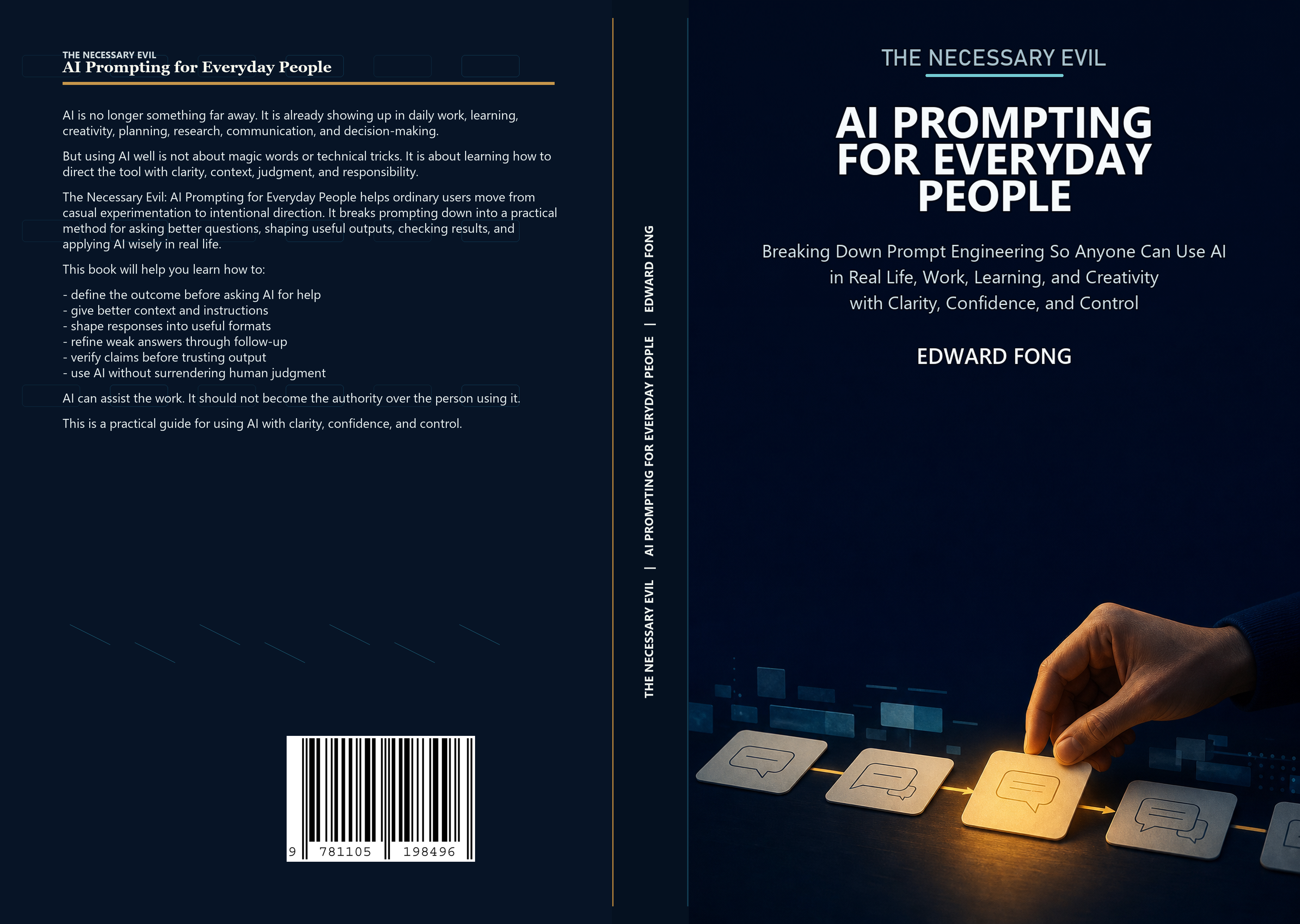
Book 2 · Direct AI clearly
The Necessary Evil: AI Prompting for Everyday People
Breaking Down Prompt Engineering So Anyone Can Use AI in Real Life, Work, Learning, and Creativity with Clarity, Confidence, and Control
A plain-English guide to becoming an intentional AI director through clearer goals, better context, useful instructions, refinement, verification, and responsible application.
This is probably for you if…
- Your AI results are inconsistent or generic.
- Prompt engineering sounds more technical than it needs to be.
- You want a method that transfers across tools and everyday tasks.
What to expect
The AI Direction Framework: Aim, Inform, Direct, Shape, Refine, Verify, Apply.
What this book is not
It is not a collection of magic words, a developer textbook, or a substitute for judgment.
Topics: practical prompting, goals, context, instruction, output shaping, refinement, verification, responsible application.
How it connects: Pair with Book 1 for risk-aware practical use, Book 3 for faithful-use boundaries, or Book 4 to move from individual prompts into structured workflows.

Book 3 · Use AI faithfully
The Necessary Evil: AI for Everyday Christian Life
A Practical Guide to Using AI with Wisdom, Discernment, and Faithfulness in Everyday Christian Life
A practical Christian guide for deciding where AI may assist—and where it must not replace Scripture, prayer, discernment, community, or responsible human action.
Scripture governs. Human judgment reviews. AI serves.
This is probably for you if…
- You want calm guidance beyond panic or blind trust.
- You are setting boundaries for faith, family, study, or church life.
- You want usefulness without treating AI as a spiritual authority.
What to expect
Practical boundaries for safe context, useful outputs, review, verification, and faithful action.
What this book is not
It is not a replacement for Scripture, prayer, pastoral care, conscience, or church community.
Topics: biblical authority, Scripture, prayer, discernment, Bible study, family, church, privacy, human responsibility.
How it connects: Book 2 helps you use AI better; Book 3 helps you decide when, why, and how to use it faithfully. Neither requires the other.

Book 4 · Orchestrate responsibly
The Necessary Evil: AI Orchestration for Real Work
How to Build Multi-Agent AI Systems That Plan, Delegate, Verify, Document, and Deliver
A practical guide to coordinating bounded AI roles, reviewable artifacts, verification, documentation, escalation, and human approval in real work.
This is probably for you if…
- You are moving beyond one-off prompts.
- Your work needs roles, handoffs, checks, and decision records.
- You want AI to prepare work while people retain approval and accountability.
What to expect
Human-governed workflow design for professional, business, creative, administrative, educational, research, technical, and ministry contexts.
What this book is not
It is not only for programmers, and it does not promise autonomous or error-free work.
Topics: orchestration, roles, delegation, handoffs, verification, documentation, escalation, human approval, accountable delivery.
How it connects: This standalone guide advances the practical path from Book 2's individual AI direction to coordinated work systems; prior reading is helpful, not required.
More than one fits?
Choose a complementary path
One book can be enough. These combinations simply show how two questions can connect; they do not imply a required sequence or purchase.
Books 1 + 2
Concerned and practical
Understand the risks and human stakes, then learn a bounded method for using AI clearly and responsibly.
Book 1 + Book 2
Books 2 + 3
Practical and faithful
Build practical AI skills while establishing distinctly Christian boundaries for authority, privacy, and discernment.
Book 2 + Book 3
Books 2 + 4
From prompts to workflows
Move from directing individual AI interactions to coordinating roles, handoffs, checks, and accountable delivery.
Book 2 + Book 4
Books 1 + 3
Dignity, faith, and boundaries
Explore the wider human stakes and the everyday Christian decisions that keep AI under proper authority.
Book 1 + Book 3
Books 1–4
The broad series progression
Follow the conceptual arc from human stakes, to clear direction, to faithful use, to responsible orchestration. Read in any order that serves your question.
Explore the Series
Keep exploring
A starting point, not a sales test
Use this guide to choose the book that meets your present need. Free companion materials are available for Books 2–4, and future articles, courses, workshops, and speaking resources can connect here as they are verified and published.