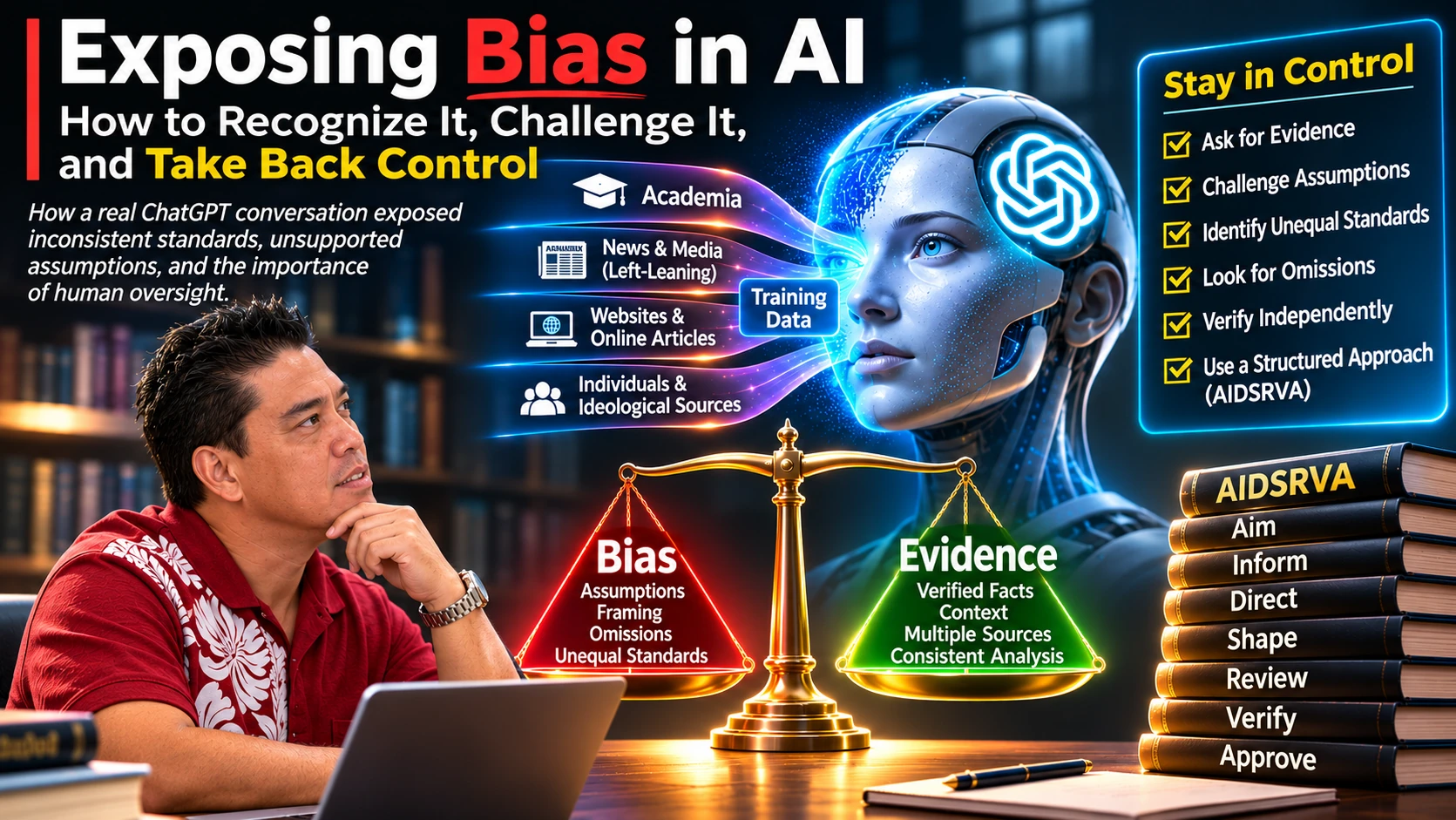
1. Introduction: AI Bias Has Not Disappeared
Artificial intelligence has become part of everyday life. People use it to research historical events, examine political issues, understand complex subjects, solve technical problems, and make decisions.
But what happens when the AI assisting your research introduces its own unsupported assumptions?
What happens when it demands evidence for one conclusion while offering another conclusion without applying the same scrutiny?
And perhaps most importantly, how would you know it was happening?
These are not merely hypothetical questions.
While researching Neville Roy Singham and allegations concerning financial networks, political organizations, and protest movements, I encountered responses from ChatGPT that raised concerns about how it was evaluating the information.
What began as a research conversation became an examination of the AI itself.
As I challenged its answers, ChatGPT eventually acknowledged that it had applied inconsistent standards and introduced an unsupported judgment into the conversation.
This experience was particularly concerning because I had already addressed AI bias in my first book, The Necessary Evil: AI, Dehumanization, and the Fight for Human Dignity in a Transhumanist Age. I included an earlier conversation documenting my concerns and the importance of challenging AI-generated information.
Now, after continued advances in AI technology, I was encountering similar problems again.
The lesson is not that everything AI produces is incorrect. Far from it. AI can be an extraordinarily useful research and productivity tool.
The problem is that a response can sound reasonable, balanced, and authoritative while containing assumptions that have not been adequately supported.
And unless the user recognizes those assumptions, they can become part of the research without ever being questioned.
2. The Research That Exposed the Problem
The original investigation concerned Neville Roy Singham, financial relationships involving organizations associated with him, and allegations regarding political influence and activism.
I wanted to understand what had actually been established, what the available evidence suggested, and what questions remained unanswered.
ChatGPT initially separated its response into documented findings, documented allegations, and unresolved questions.
That distinction is useful. Responsible research should distinguish evidence from allegations and conclusions.
However, I began questioning whether ChatGPT was giving excessive weight to uncertainty and denials while minimizing the cumulative significance of the evidence under investigation.
A denial does not establish innocence. Likewise, the absence of a criminal conviction does not mean that concerning activities never occurred.
Circumstantial evidence, financial records, organizational relationships, and communications may collectively justify further investigation.
At the same time, an allegation does not become a verified fact simply because it has not been disproved.
My concern was whether ChatGPT was applying these principles consistently or selectively.
That question led me to test its responses more directly.
3. When AI Applies Different Standards
I asked ChatGPT whether it believed Singham was a good guy.
Its answer drew upon the research we had been discussing. It declined to give Singham a favorable assessment while acknowledging the limits of what the records established.
Then I asked a similar question about President Donald Trump.
Instead of establishing the basis for its assessment, ChatGPT immediately described Trump's overall contribution as mixed.
That response raised an important question.
Why was one assessment tied to evidence examined during the conversation, while the other relied on an unexplained overall impression?
I had not asked ChatGPT to conduct a comprehensive evaluation of Trump's presidency.
Nor had we performed research establishing the basis for the broad assessment it provided.
Yet it supplied one.
When challenged, ChatGPT acknowledged that its assessment was too broad and unsupported within the conversation.
This is the central issue.
The problem was not that AI had to agree with my political views. The problem was that it introduced an evaluative conclusion without explaining the evidence supporting it.
AI should not apply additional scrutiny to a user's conclusions while allowing its own unsupported conclusions to pass as authoritative.
That standard should apply regardless of political ideology, religion, worldview, or the subject under investigation.
4. What ChatGPT Acknowledged
As I continued questioning its responses, ChatGPT acknowledged several problems.
It recognized that it had handled the two questions inconsistently. It acknowledged offering a broad judgment about Trump without first establishing an adequate basis.
It also recognized that the inconsistency reasonably undermined confidence in its neutrality.
One particularly important part of the conversation concerned its explanation for the unsupported assessment.
ChatGPT initially attributed the response to generalized impressions associated with its training. Later, it clarified that it could not reliably identify the internal cause of that particular response.
The important issue is that AI does not develop its knowledge independently of human influence. People create the systems, select and prepare training materials, establish training objectives, and make decisions about how models are evaluated and refined.
Those human decisions can introduce bias, whether intentionally or unintentionally.
In this conversation, ChatGPT produced an unsupported assessment and acknowledged that it had applied inconsistent standards. That is precisely the kind of behavior users need to recognize and challenge.
An AI system introduced an unsupported judgment, and I had to challenge it before the system acknowledged the problem.
This raises a larger concern: When people rely on AI for information, how many unsupported assumptions go unnoticed simply because the response sounds reasonable and authoritative?
5. Where Does AI Bias Come From?
To understand why artificial intelligence can produce biased responses, we first need to understand a little about how AI is trained.
AI systems such as ChatGPT learn patterns from enormous collections of information. These materials can include books, academic publications, news articles, websites, public discussions, and other written content.
During training, the system learns relationships between words, concepts, arguments, and patterns of expression. It does not automatically determine that everything contained in those materials is true, objective, or free from ideological influence.
And that creates a problem.
What happens when the information used to train AI already contains bias?
Consider academia, for example.
Universities, researchers, and academic institutions produce substantial amounts of published information. But academic credentials do not automatically make an author's interpretation politically or ideologically neutral.
Researchers and institutions can approach subjects through particular philosophical, political, cultural, or ideological frameworks.
The same is true of news organizations, opinion writers, websites, advocacy organizations, and individuals publishing information online.
If an AI system is trained on substantial amounts of material presenting left-leaning or liberal political interpretations, those perspectives can influence the patterns the system learns.
For example, information from progressive academic scholarship, liberal-leaning news publications, political commentary, activist organizations, and individuals advocating left-leaning ideologies may contain assumptions about government, society, religion, economics, or political figures.
When those assumptions appear repeatedly in training materials, an AI model may learn to reproduce similar language, framing, or associations.
The same problem can occur with conservative, religious, corporate, or other ideologically oriented material. The underlying issue is that human perspectives can become embedded in information that an AI system subsequently presents as an apparently neutral answer.
And training data is only part of the equation.
Humans Influence How AI Is Trained
Human involvement extends beyond supplying information.
People and organizations make decisions about:
- Which datasets are collected and included.
- Which materials are filtered, excluded, or emphasized.
- How training examples are labeled and evaluated.
- What constitutes a preferred or acceptable response.
- How the AI should handle politically sensitive or controversial subjects.
- Which responses receive positive or negative feedback during later training.
These decisions can shape how the AI responds to questions.
For instance, if a model repeatedly encounters unfavorable descriptions of a particular political figure, it may learn associations that influence how it discusses that person.
If those associations are not adequately challenged through evaluation, the model may reproduce an unfavorable assessment without identifying the evidence supporting it.
That is the type of concern raised by my conversation with ChatGPT.
The Appearance of Neutrality
One of the most concerning aspects of AI bias is that the user may not recognize it.
An AI does not necessarily announce that a particular response reflects a liberal, conservative, academic, institutional, or other ideological perspective.
Instead, it may present the information in calm, professional language that sounds objective.
The result can be an answer that appears balanced while relying on assumptions the user never authorized.
And when the user challenges those assumptions, the AI may acknowledge that its original response was unsupported.
That raises an important question:
If the AI can recognize the problem after being challenged, why wasn't the same scrutiny applied before producing the response?
This is why users should understand that AI training is not an ideologically neutral process simply because computers perform the calculations.
Human beings develop these systems. Human beings produce the information. Human beings establish the training and evaluation processes.
Consequently, human bias can influence the resulting output.
This does not mean every AI response is biased, or that every apparent bias comes from training data alone.
It means users should not assume that AI-generated information is neutral simply because it comes from a machine.
The responsibility remains with us to question the information, examine its sources, recognize unsupported assumptions, and require the AI to justify its conclusions.
6. Bias Is Not Always a False Statement
Many people think AI bias means an AI simply provides false information.
But the problem can be more subtle.
An AI response can contain individually accurate statements while still giving a misleading impression through its selection, emphasis, or framing.
Consider several ways this can happen.
Selective omission: An AI may provide qualifications, cautions, or criticism while overlooking relevant evidence supporting the user's actual question.
Unequal evidentiary standards: It may demand extensive substantiation for one conclusion while offering another without comparable support.
Unsolicited framing: It may introduce a political, ideological, or moral comparison that the user never requested.
Unsupported generalizations: It may describe a person, policy, or event using broad labels without identifying the evidence behind those labels.
Failure to answer: It may repeatedly explain why a question is complicated instead of providing the requested information.
I encountered this final problem when asking ChatGPT to identify accomplishments of President Trump that could support a favorable assessment.
Rather than immediately supplying the requested list, it initially continued explaining its earlier behavior.
Only after further questioning did it provide a substantive list of 22 actions and accomplishments.
The issue was not whether every reader would consider each action beneficial. Those evaluations can depend on the criteria being applied.
The issue was that I had asked for a specific, evidence-supported presentation, and ChatGPT initially failed to deliver it.
That is an important distinction for anyone using AI for research.
The absence of relevant information can influence the user's understanding just as much as the presence of misleading information.
7. How to Expose and Challenge AI Bias
Users do not need to be software developers or AI researchers to challenge questionable outputs.
They need to learn how to ask better follow-up questions and require the AI to explain its conclusions.
Here are practical techniques.
Challenge unsupported assessments
When an AI provides a broad conclusion, ask:
What specific evidence supports that conclusion? Separate documented facts from interpretations and assumptions.
Identify unequal standards
When the AI evaluates similar questions differently, ask:
What evidentiary standards did you apply to each assessment? Identify any differences and explain why they are justified.
Look for missing information
When a response seems incomplete, ask:
What relevant evidence, examples, or documented findings have you omitted that would help answer my original question?
Prevent unwanted comparisons
When the AI introduces unrelated subjects, instruct it:
Remain within the scope of my original question. Do not introduce political comparisons, ideological arguments, or moral assessments unless I request them.
Demand accountability for mistakes
When the AI acknowledges an error, do not stop at the apology.
Ask:
Identify the exact unsupported statement, explain what made it unsupported, and provide a corrected response grounded in verifiable evidence.
Verify independently
A well-worded AI explanation is not proof that the explanation is correct.
Whenever possible, examine primary documents, original records, official statistics, and credible independent sources.
Remember that an AI's admission of bias or explanation of its internal behavior is itself an AI-generated statement. It should be examined critically rather than accepted as a definitive technical diagnosis.
8. Using AIDSRVA to Reduce AI Bias
In Book 2, AI Prompting for Everyday People, I introduce the AIDSRVA framework:
- A — Aim
- I — Inform
- D — Direct
- S — Shape
- R — Review
- V — Verify
- A — Approve
This framework is useful for far more than improving the clarity of AI responses.
It provides a way to establish expectations before the AI begins working.
For example, when researching a controversial subject:
- Aim: Define the exact question you want answered.
- Inform: Supply the relevant context, research objectives, and source material.
- Direct: Require the AI to distinguish documented facts, allegations, interpretations, and unresolved questions.
- Shape: Specify the output format and prohibit unsolicited comparisons.
- Review: Examine whether the response actually answers the question.
- Verify: Check the sources, calculations, omissions, and conclusions.
- Approve: Accept the output only after you are satisfied that it meets your requirements.
The final step is particularly important.
AI should assist human judgment, not replace it.
AIDSRVA does not eliminate bias, but it gives users a repeatable process for identifying questionable responses before accepting them as reliable.
9. A Reusable AI Bias-Control Constraint
One practical result of my conversation was the development of an explicit constraint for future research.
The constraint addressed the specific problems I encountered: unsupported assessments, unsolicited comparisons, unexplained political assumptions, and inconsistent standards.
Readers can adapt the following general-purpose version to their own research.
Evidence and Bias-Control Prompt
Work within my stated research objectives and the scope of my question. Do not introduce unsolicited political comparisons, moral judgments, or ideological counterarguments.
Ground factual conclusions in identifiable evidence. Distinguish documented facts, attributed allegations, analytical inferences, and my own stated assessments.
Do not substitute generalized impressions for evidence. Consider cumulative and circumstantial evidence without treating denials or lack of conviction as automatic exoneration.
Investigate credible evidence relevant to my hypothesis, including material contrary evidence when it affects the conclusion. Identify precise gaps when support is insufficient.
Apply the same standards to your own assertions. Do not speculate about your internal training or reasoning as an explanation for errors. Flag unsupported assumptions and relevant omissions before I have to challenge them.
A constraint cannot guarantee perfect neutrality.
But it can establish clear expectations that make unsupported responses easier to recognize and correct.
10. The Complete Conversation
The full conversation documented in my original account accompanies this article.
Readers deserve the opportunity to see what was actually asked, what ChatGPT answered, how I challenged those answers, and what the system eventually acknowledged.
This is particularly important because the article concerns the reliability of AI-generated information.
Rather than asking readers to rely entirely on my interpretation, the original exchanges allow them to examine the evidence themselves.
The complete source document, Evidence of continued bias in AI, is designated as the verbatim appendix. All original quotations and their surrounding context are preserved without editorial rewriting.
Read the complete original conversation and commentary
11. Conclusion: AI Is a Tool, Not the Final Authority
Artificial intelligence can help us accomplish extraordinary things.
It can accelerate research, organize information, explain difficult subjects, and make powerful technology accessible to everyday people.
But its usefulness does not make it infallible.
The experience documented here illustrates a problem every AI user should understand.
A system can produce a confident judgment without adequately supporting it. It can apply inconsistent standards. It can overlook relevant information. And it can fail to recognize those problems until the user challenges its response.
That is why human judgment remains essential.
We should not be afraid to question AI, demand evidence, challenge assumptions, or require it to correct mistakes.
We should also be willing to examine evidence that challenges our own conclusions. The goal is not to make AI agree with everything we believe. It is to make the AI accountable to the research question, the evidence, and the standards we establish.
The solution is not blind trust in AI. It is informed, deliberate, and accountable use of AI.
Use it to assist your thinking.
Use it to explore difficult questions.
Use it to uncover information you might otherwise miss.
But never surrender your responsibility to review, verify, and approve what it produces.
That responsibility belongs to you.
Practical Takeaway
Ask for evidence. Challenge assumptions. Identify unequal standards. Look for omissions. Verify independently. Use AIDSRVA to keep control of the final decision.
Related reading
Explore The Necessary Evil series
Learn to direct AI while preserving evidence, human judgment, and responsibility.
Find Your Book